
How I Got Started with OpenCode and Now Feel Like I Can Apply to YC

Photo from Unsplash.
How I Got Started with OpenCode and Now Feel Like I Can Apply to YC
I'm cheap—and when I see I'm nearing capacity in my primary AI tools, I route long, structured work somewhere else. Opencode is where I paste 2,000+ word prompts, switch agents, and @ whole folders (including my YC exploration workspace on Google Drive) so one run carries my profile, constraints, and instructions without chewing through my day-to-day editor limits.
How to get started
Install: Pick one:
curl -fsSL https://opencode.ai/install | bash- Or with Homebrew:
brew install anomalyco/tap/opencode
You need API keys for whatever providers you want (OpenAI, Anthropic, OpenRouter, etc.). Connect them with /connect.
First screen: Open opencode and you get a single prompt: "Ask anything…" with modes like Plan, Big Pickle, OpenCode, Zen. No clutter.
 opencode interface: Ask anything prompt with Plan, Big Pickle, OpenCode, Zen and keyboard shortcuts.
At the top of every chat, opencode shows capacity, context window, and cost. I love that—seeing usage and ($0.00) right there keeps me aware.
 opencode chat header: capacity 128,308, 64% usage, $0.00 cost, v1.1.52.
Shortcuts that matter:
ctrl+t— variants (try different responses)tab— switch agentctrl+p— commands- Start a message with
!— run shell commands
Switch agent or context: When one model isn't the right fit, hit tab or /agents. You get a list of agents (Build, Big Pickle, OpenCode, Zen) or contexts (@general, @explore, or paths on disk).
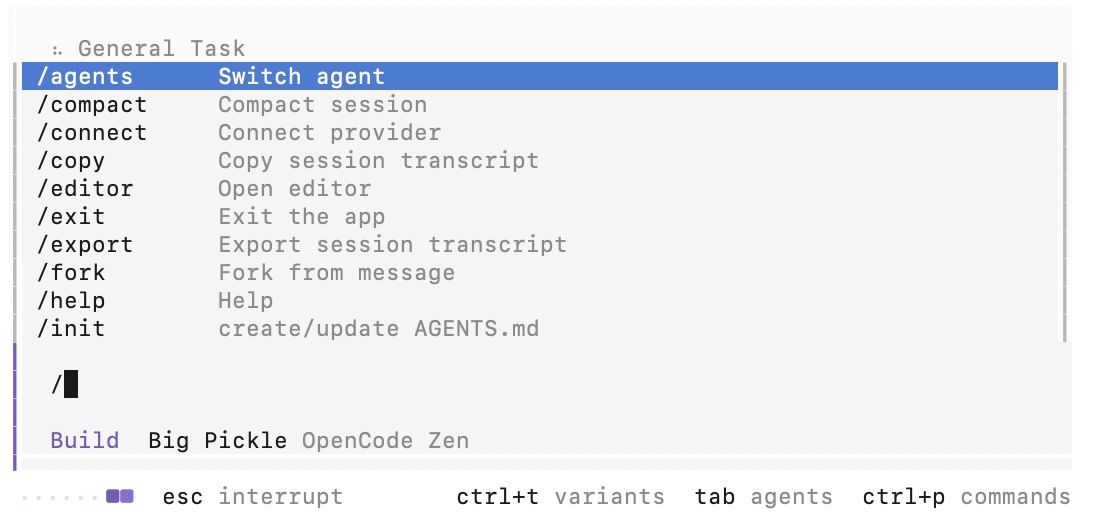 opencode command palette: Switch agent - Build, Big Pickle, OpenCode, Zen.
 opencode context switcher: @general, @explore, Build, Big Pickle, OpenCode, Zen.
My Explore/YC folder (Google Drive)
Under Google Drive → Explore/YC I keep a small set of markdown files I can @-reference together in opencode:
| File | What it's for |
|---|---|
YC-STRATEGIC-ANALYSIS-PROMPT.md | Full long prompt (market, founder fit, feasibility, YC readiness, roadmap, risks, KPIs). |
YC-STARTUP-EXPLORATION.md | Experience and assets mapped to ranked startup angles and YC narratives. |
YC-STARTUP-OPTIONS.md | Wide option matrix (security, governance, founder-fit ideas). |
YC-PROJECTS.md | Deeper briefs on specific product concepts. |
Typical run: @Explore/YC (or each file), then a message like "Using my profile and constraints in the prompt file, produce an updated exploration section for OpenPinas vs Cursor-for-PMM—rank by YC readiness." I save answers back into those docs so the work compounds instead of living only in chat.
Case study: YC strategic analysis
What I wanted to test. I have a long prompt I use for YC-style startup exploration—market opportunity, founder–market fit, technical feasibility, business model, competitive positioning, implementation roadmap, risks, metrics. It's the kind of thing that would chew through Cursor capacity or a lot of API tokens in one go. I wanted to see if opencode could handle it and give me usable, structured output.
Why opencode for this. (1) Capacity. Running a 2,000+ word prompt and a long response in Cursor would push my usage; in opencode I could point at a model I already had connected (e.g. via OpenRouter) and keep Cursor for day-to-day coding and content. (2) Dedicated run. Strategic analysis benefits from a single, focused session—no mixing with other chats. (3) Agent switch. If the first agent didn't structure the answer well, I could switch and retry without starting over.
What I did. I pasted the full prompt (the one below) into opencode. One shot. I used an agent/model that supports long context and structured output. I didn't tweak the prompt for opencode; I used it exactly as I'd use it elsewhere.
What I got. A long, sectioned response: market opportunity, founder–market fit, technical feasibility, business model, competitive positioning, implementation roadmap, risks, metrics, and a final recommendation. Tables where the prompt asked for them, clear headings, actionable next steps. Not perfect—I'd still edit and validate—but way better than I expected for a first run. No download, no extra tooling; just paste and go.
Takeaway. Opencode handled a heavy, structured prompt without burning my main Cursor capacity. That's the catalyst: saving capacity while still getting a serious analysis. If you have a long prompt you've been reluctant to run in your primary AI app, opencode is a good place to test it.
Prompt snippet (copy-paste shape)
The real file is long on purpose. Here's the opening + profile + start of the ask so you can see the structure; Parts 2–10 in the Drive file cover founder–market fit, feasibility, business model, positioning, YC application strategy, roadmap, risks, metrics, and final recommendation.
# STRATEGIC STARTUP ANALYSIS PROMPT

## CONTEXT
I am a solo founder exploring startup opportunities for YC Summer/Fall 2026 application.
I need comprehensive analysis of options that align with my unique background, constraints, and goals.

## MY PROFILE
### Background & Expertise:
- **Professional background**: 10+ years PMM, product marketing, go-to-market strategy, developer tools marketing
- **Current role**: Head of PMM at AI cybersecurity startup (day job)
- **Technical skills**: AI cybersecurity, enterprise security, software supply chain, API integration, data privacy
- **Teaching experience**: Product School instructor, Maven top instructor, Udacity top instructor, Fiverr top instructor
- **Speaking**: RSA speaker, Gainsight Pulse speaker, Pavilion SF Chapter Head
- **Networks**: Strong in security, PMM, AI startup communities
- **Content creation**: Daily AI tooling experience, blog author, course creation
- **Geographic/Cultural**: Filipino American context, global diaspora perspective
- **Time availability**: 10-15 hours per week for startup development
- **No technical co-founder**: Must work solo with API-first approach
- **YC timeline**: Summer 2026 or Fall 2026 application windows
- **Funding constraints**: Limited personal budget, need revenue quickly

### Constraints:
- **Time**: 10-15 hours/week maximum for focused work
- **Technical**: Can build with existing APIs and no-code tools, but not deep coding
- **Budget**: $500-1000 for tools, minimal marketing spend
- **Timeline**: Need MVP in 4-6 months to apply for YC
- **Skills gap**: Strong in marketing/PM but limited in frontier AI/ML engineering
- **Risk tolerance**: Medium-high (need income stability but can take calculated risks)
- **Goals**: Primary goal is YC acceptance, secondary is sustainable business
- **Long-term**: Want to build expertise and brand beyond just one YC batch

### Goals:
- **Primary**: Get into YC with strong application (Summer/Fall 2026)
- **Secondary**: Build sustainable business regardless of YC outcome
- **Tertiary**: Establish thought leadership and brand authority in AI + PMM space
- **Lifestyle**: Income stability through multiple revenue streams (courses, consulting, SaaS)
- **Impact**: Solve meaningful problems, not just pursue financial success

## ANALYSIS REQUEST

### Part 1: Market Opportunity Analysis
Research and analyze:
1. **Emerging Trends**: What's becoming urgent but not yet saturated in startup/YC conversations?
2. **Regulatory Changes**: What new laws/compliance needs are emerging that create startup opportunities?
3. **Technology Shifts**: What frontier model capabilities are becoming accessible that most founders can't yet leverage?
4. **Market Gaps**: What problems are underserved by current solutions?
5. **Timing Analysis**: Which opportunities have perfect market timing vs. which are too early/late?
6. **Competitive Landscape**: How crowded are different sectors and what are sustainable competitive advantages?
7. **SWOT Analysis**: For each opportunity, strengths, weaknesses, opportunities, threats

### Part 2: Founder-Market Fit Analysis
For each opportunity identified:
1. **Background Alignment**: How well does this match my expertise, experience, and networks?
2. **Network Leverage**: What existing relationships and audiences can I utilize?
3. **Unique Advantage**: What can I do that others can't replicate based on my background?
4. **Credibility**: Do I have existing authority or can I build it quickly?
5. **Passion & Interest**: How excited am I about this problem space personally?
6. **Resource Requirements**: What technical skills, time, and budget do I need?
7. **YC Readiness**: What would make this attractive to YC specifically?

### Part 3: Technical Feasibility Assessment
For each opportunity:
1. **Complexity Rating**: 1-5 scale (1=very simple, 5=very complex)
2. **Solo Build Timeline**: How many weeks to MVP with 10-15 hours/week?
3. **API Requirements**: What existing tools/APIs can I leverage vs. what needs custom development?
4. **Technical Risks**: What could go wrong technically and how to mitigate?
5. **Scalability Path**: How does this scale from MVP to enterprise product?
6. **Dependencies**: What external services or partnerships are needed?

### Part 4: Business Model & Revenue Analysis
For each opportunity:
1. **Revenue Model**: SaaS subscription, usage-based pricing, marketplace, enterprise contracts, etc.
2. **Pricing Strategy**: Free tier, professional tiers, enterprise pricing, usage limits
3. **Time to First Revenue**: How many months from MVP to first paying customer?
4. **Revenue Potential**: What's realistic MRR/ARR at 6 months, 1 year, 2 years?
5. **Unit Economics**: Customer acquisition cost, lifetime value, churn rates
6. **Scaling Strategy**: How to grow from initial to enterprise scale?
7. **Capital Efficiency**: How efficiently can I turn time into revenue?

### Part 5: Competitive Positioning
For each opportunity:
1. **Direct Competitors**: Who are the existing players and what are their limitations?
2. **Indirect Competitors**: What alternatives or adjacent solutions exist?
3. **Differentiation Strategy**: How do I stand out from competitors?
4. **Barriers to Entry**: What protects existing players and how can I bypass them?
5. **Network Effects**: How does this create compounding advantages?
6. **Partner Opportunities**: Who could I partner with for distribution or technical capabilities?
7. **"Why Us" Narrative**: Why is my solution uniquely qualified to solve this problem?

### Part 6: YC Readiness & Application Strategy
For top 2-3 opportunities:
1. **YC Targeting**: Which YC partners, alumni, or batch characteristics align?
2. **Application Timeline**: When to apply for optimal batch acceptance?
3. **Traction Requirements**: What metrics, user numbers, revenue needed for strong application?
4. **Story Elements**: What narrative elements resonate with YC values and current trends?
5. **Risk Mitigation**: What could go wrong and how to prevent?
6. **Interview Preparation**: What questions should I anticipate and how to prepare?
7. **Alternative Strategies**: What if YC doesn't work out - plan B, pivot, continue building?

### Part 7: Implementation Roadmap
For primary choice:
1. **Phase 1 (Weeks 1-4)**: MVP development with resource allocation
2. **Phase 2 (Weeks 5-8)**: Beta testing, customer feedback, iteration
3. **Phase 3 (Weeks 9-12)**: Launch preparation, marketing push, early traction
4. **Phase 4 (Weeks 13-16)**: YC application, interview prep, batch decision
5. **Phase 5 (Post-YC)**: Acceleration, scaling, team building

For secondary choice:
1. **Parallel Development**: Build secondary opportunity while pursuing primary
2. **Contingency Planning**: What if primary fails or needs more time?
3. **Pivot Strategy**: How to transition from secondary to primary if needed?
4. **Resource Allocation**: How to split time between opportunities?

### Part 8: Risk Mitigation Strategies
1. **Technical Risks**: Technology failures, security vulnerabilities, scalability issues
2. **Market Risks**: Timing wrong, competition intensifies, market doesn't develop
3. **Execution Risks**: Founder burnout, team building challenges, capital inefficiency
4. **Regulatory Risks**: Compliance failures, legal issues, policy changes
5. **Competitive Responses**: How to react to competitors, price wars, feature copy
6. **Personal Risks**: Income instability, opportunity cost, reputation damage
7. **Mitigation Plans**: How to prevent, monitor, and respond to each risk type

### Part 9: Success Metrics & KPIs
For YC application and beyond:
1. **Traction Metrics**: Users, revenue, growth rates, engagement, retention
2. **Product Metrics**: Feature usage, performance, uptime, security metrics
3. **Financial Metrics**: MRR, ARR, cash burn, customer acquisition cost, LTV
4. **Operational Metrics**: Development velocity, customer support time, bug resolution
5. **Network Metrics**: Community growth, partnerships, content reach, speaking engagements
6. **YC Specific**: Application strength scores, interview success rates, batch compatibility
7. **Long-term Metrics**: Market share, profitability, sustainability, brand authority

### Part 10: Final Recommendation
Based on all analysis, provide:
1. **Primary Choice**: Which opportunity to pursue with full focus
2. **Secondary Choice**: Backup option if primary doesn't work out
3. **Strategic Rationale**: Clear reasoning for the recommendation
4. **Implementation Timeline**: Specific weeks and milestones for execution
5. **Success Criteria**: What metrics and outcomes determine success
6. **Risk Assessment**: Honest evaluation of risks and mitigation strategies
7. **Next Steps**: Immediate actions to take based on decision

## OUTPUT REQUIREMENTS

### Format:
- Use markdown with clear sections and subsections
- Include tables for comparison and scoring
- Provide actionable recommendations with timelines
- Include risk assessments and mitigation strategies
- Provide specific metrics and targets
- Use data-driven analysis where possible
- Be honest about constraints and trade-offs

### Sources to Consider:
- YC application data from recent batches
- Market research reports (industry analysis, TAM estimates)
- Competitor websites and public information
- Technical documentation and API capabilities
- Network contacts for validation calls
- My own skills, experience, and constraint assessment

## EXECUTION INSTRUCTIONS

1. **Research Phase**: Spend time gathering data before building
2. **Analysis Phase**: Use structured approach to evaluate options objectively
3. **Decision Phase**: Make choice based on weighted criteria, not just excitement
4. **Validation Phase**: Test assumptions with real customers before full commitment
5. **Implementation Phase**: Execute with measurable milestones and regular check-ins

## EXPECTED DELIVERABLES

1. **Market Opportunity Report**: Comprehensive analysis of emerging trends and gaps
2. **Competitive Landscape Map**: Detailed analysis of existing players and opportunities
3. **Technical Feasibility Study**: Honest assessment of what can be built solo
4. **Business Model Analysis**: Revenue projections and unit economics for each option
5. **Implementation Roadmap**: Week-by-week plan with resource allocation
6. **YC Application Strategy**: Timeline and requirements for successful application
7. **Risk Assessment & Mitigation**: Potential failures and prevention strategies

---

**Use this prompt template to create strategic analysis that rivals professional startup consultancies. Focus on data-driven decisions while leveraging your unique background and constraints.**
Change the MY PROFILE section to your situation, paste into opencode (or any long-context AI), and run it. No download—just an example of how I tested opencode and was impressed. If you try it, I'm curious what you get—LinkedIn or check back here.
— Beatriz
What I got back (sample)
This is trimmed from YC-STARTUP-EXPLORATION.md after a full pass—ranked angles, YC narrative, what to tighten—not a vague bullet list:
Angle 1: OpenPinas → Civic / diaspora data company (highest "already a product")
What you have: Live site, 50+ dynasties, 450+ members, business connections data, timeline, weekly digests, open JSON. Built for diaspora context. No other product in the workspace is as "shippable" and unique.
YC narrative: "Transparency and context for 10M+ Filipino diaspora: power structures, business–politics links, and news in one place. We started with open data and visualizations; we're adding API/data products for media, NGOs, and researchers (or a subscription for diaspora)."
To strengthen for YC: Define one clear revenue path (e.g. API, data licensing, premium diaspora subscription, or grants/NGO contracts). Add 1–2 key metrics (weekly actives, API calls, or paying organizations). AI/model differentiator: model-generated digests, summaries from timeline + dynasty data, or analytical layers on top of the JSON—civic data plus AI, not just static datasets.
Takeaway: Opencode handled a heavy, structured prompt without burning my main Cursor capacity—and @Explore/YC meant the model wasn't inventing my background from scratch. If you've been sitting on a long prompt because your default tool feels too "metered," this workflow is the workaround I actually use.